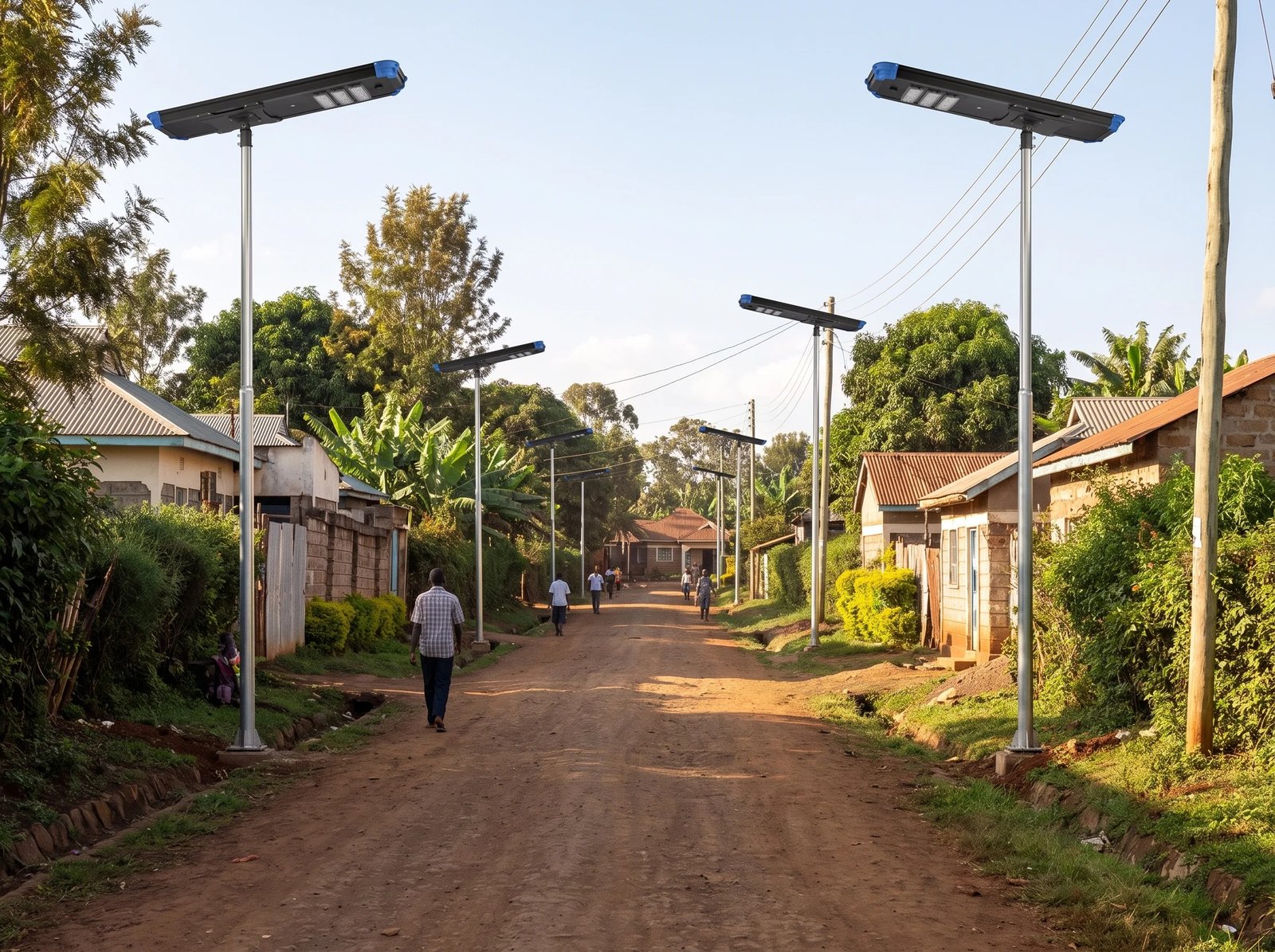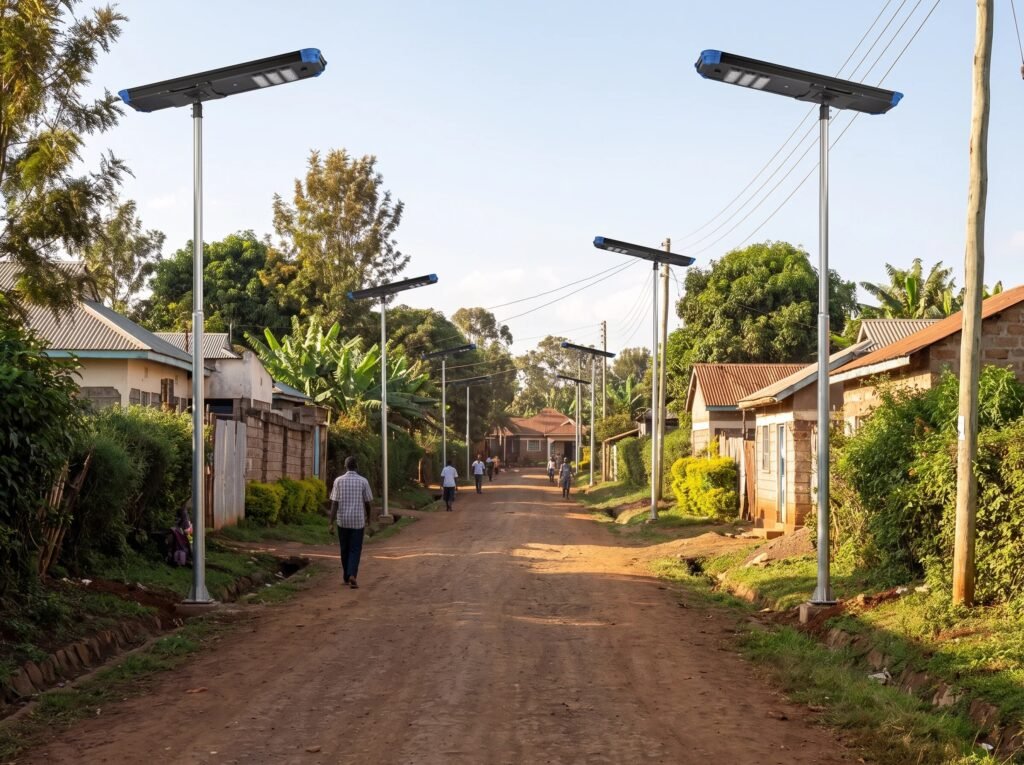
Street lighting is one of the last items many developers think about on a new housing project, and one of the first things residents notice. A dark access road or an unlit footpath can make a brand-new estate feel unsafe, slow down sales and lead to complaints long after handover. Solar street lighting solves many of these problems, but only if it is planned properly from the start.
This guide explains how builders and developers can plan solar street lighting for new housing developments: what to decide early, how to avoid the common traps, and how to hand over a system that will keep working for years.
Why Solar Makes Sense for New Housing Developments
On a greenfield site, conventional street lighting means trenching cables along every road, installing feeder pillars, applying for grid connections and waiting for the utility to energize the network. Each step adds cost and time, and each one depends on someone else’s schedule.
Solar street lights remove most of that work. Each light produces and stores its own power, so there is no cabling between poles and no connection to wait for. For developers, that brings several practical benefits:
- Lighting from the first phase. Roads and show-home areas can be lit as soon as poles are installed, even before the grid reaches the site.
- Less civil work. No cable trenches along roads and footpaths, which also means fewer conflicts with water, drainage and telecom services.
- Phased installation. Lights can be added street by street as each phase is completed.
- No electricity bills. A selling point for buyers and for the residents’ association or municipality that will take over the roads.
- Light during power cuts. In areas with an unreliable grid, solar lighting keeps the estate lit when the neighbourhood goes dark.
Step 1: Agree on Who Will Own the Lights
Before choosing a product, settle who will own and maintain the lighting after handover. In some places, the municipality adopts the roads and lighting once they meet its standards. In others, a residents’ association or management company takes responsibility. The future owner may have its own specification, approved suppliers or lighting standard, and finding that out late can mean replacing lights that were already installed.
Step 2: Set the Lighting Level for Each Type of Road
Not every part of an estate needs the same light. A main access road with traffic needs more light and better uniformity than a quiet cul-de-sac or a pedestrian path. Many countries follow a lighting standard, such as EN 13201 in Europe, that sets lighting classes for different road types.
A typical development might use:
- Higher output lights on taller poles for the main access road and entrance.
- Medium output for internal residential streets.
- Lower, warmer light on shorter poles for footpaths, parks and play areas.
Getting this right avoids two common problems: dark spots between poles on the main road, and over-lit residential streets that shine into bedroom windows.
Step 3: Ask for a Lighting Design
Pole spacing should come from a lighting calculation, not from habit. A lighting design in a tool such as DIALux models the actual road layout, places the lights at the proposed height and spacing, and shows whether each road reaches its lighting level. It also helps the developer avoid buying more poles than necessary, which is often where the biggest savings are.
Experienced manufacturers usually provide this design as part of the project. Specialists in solar street lighting for urban and municipal roads can also advise on what the adopting authority is likely to require.
Step 4: Size the System for the Worst Month
The most common failure in solar street lighting is a system sized for a sunny average day. In the rainy season or in winter, an undersized battery and panel cannot keep the lights on all night. When comparing offers, ask each supplier for:
- The solar panel wattage and battery capacity for each light.
- The battery chemistry. LiFePO4 lithium batteries are now standard for quality systems.
- How many cloudy days the system can run without sun (autonomy).
- The dimming profile, for example full brightness in the evening and reduced output after midnight.
A supplier that answers these questions clearly is far more likely to deliver lights that work through the whole year.
Step 5: Choose Between All-in-One and Split Systems
Housing developments usually use one of two designs. All-in-one lights combine the panel, battery and LED in a single compact unit. They install quickly and look neat, which makes them popular for residential streets and paths in sunny regions. Split systems mount a larger panel separately on the pole, which suits main roads, taller poles and less sunny climates. Many estates use a mix of both.
Step 6: Plan Poles, Foundations and Security
Solar poles carry a panel as well as a light, so they face more wind load than ordinary lighting poles. Check that the pole and foundation are rated for local wind conditions, and coordinate foundation positions with driveways, services and landscaping early in the site layout. For security, sealed batteries at the top of the pole and tamper-resistant fixings discourage theft, which matters on sites that will be partly empty during construction.
Step 7: Think About Residents
Good lighting on a housing estate is about comfort as well as safety. Warmer colour temperatures and well-shielded optics reduce glare and light spilling into homes. Motion-sensing or dimming profiles can keep paths lit while saving energy late at night. These details are small at the design stage and difficult to change later.
Step 8: Plan the Handover
When the estate is handed over, the new owner needs as-built drawings showing every light, the product and warranty documents, the maintenance schedule and a contact for spare parts. Solar street lights need little maintenance, mainly periodic panel cleaning and planned battery replacement, but someone needs to know when and how to do it.
Common Mistakes to Avoid
- Leaving street lighting until the roads are finished, then retrofitting poles around new driveways.
- Choosing lights on price and wattage alone, without a lighting design.
- Sizing batteries for an average day instead of the worst month.
- Ignoring the adopting authority’s requirements until handover.
- Using bright, cold light on residential streets where residents will complain about glare.
Final Thoughts
Solar street lighting can make a new housing development safer, faster to build and cheaper to run, but the results depend on decisions made early: who owns the lights, what each road needs, a proper lighting design and a system sized for the hardest month of the year. Developers who plan this with an experienced manufacturer avoid costly changes later. Many manufacturers offer a free solar street lighting project consultation, which is a good first step before the site layout is fixed.